1/31/2024

History of White/White Translucent Nerikomi 1995~

Dorothy Feibleman started her laminated porcelain expression in 1969 while at Rochester Institute of Technology, Rochester, New York. She exhibited her work in many shows from that time (CV on dorothyfeibleman.com). She moved to the UK in 1973 upon graduation and travelled frequently in Eastern Europe, photographing village crafts and customs for a Children’s Museum she worked at as a volunteer since the age of 10. When she was 17 they paid for her to photograph the crafts in Europe. Her ceramic and gold jewelry and laminated translucent porcelain was purchased in 1981-3 by the Victoria and Albert Museum for the Jewellery and the Ceramic galleries in the Museum. Her translucent nerikomi was in the first Mino Competition in Gifu Japan in 1986. Before she developed the Potterycraft colored porcelain she had been working on white white in the late 1970s-1980s. But she was excited by new color stains available and formulated a range of mixable colors. She first came to Japan in 1993 as a design prize winner at Inax Corporation in Tokoname Japan and showed in Tokyo. In 1996 she attended the IAC meeting in Japan and showed her work in Saga, Japan. Translucent porcelain was not a traditional material used for neriage in Japan or Jiao-tai in China. Some vaguely translucent nerikomi was used for Bankoware teapots but was not used in a translucent way. Anyway,the process was not referred to as nerikomi until Yusuke Aida conjured up the description to refer to his work - as Dorothy entered on Wikipedia - if needed for research reference look at the meta data.
(Asymmetrical translucent nerikomi textured piece above is in the Indianapolis Museum of art) (The translucent textured sake cup above was seen by Matsui Kousei before he bought her DF Potterycrafts porcelain) (Both are not well lit for the camera to read the translucency.) In 1997 she stayed as a guest artist at Togei no Mori in Shigaraki prefecture Japan. One of the White/White Asymetrical pieces she made at Togei no Mori in 1997 was purchased for the Metropolitan Museum of Art in NYC after it had been in the Mino competition. She made other works at Togei no Mori some of which are also in the Museum of Contemporary Ceramic collection in Shigaraki. She made white/white work as well as colored nerikomi (laminated porcelain) on that residency. She also gave a lecture at Togei no Mori (Pottery in the Woods) in 1997 about her colored work and white/white translucent textured and not textured work. In this lecture she detailed her history and development of her white/white expression. She also talked about her study of East European fabric and costume construction and the crafts she documented for the Children’s Museum as well as the leather clothing she sold in high school so that she could travel to Europe to photograph the crafts in villages in Transylvania. She moved to England in 1973 and attended the University of London and studied Hungarian Language in 1975. She travelled to China in 1998 and exhibited her work in the museum in Yixing and and lectured at the Art University in Jingdezhen. She talked about her porcelains she developed and about the Hungarian porcelain containing Czech kaolin and about the feldspars she used in her porcelains. She also lectured in Shigaraki Ceramic Technology Institute in 1998 about her white/ white translucent nerikomi she developed and finally had good results in 1995 in the UK and Hungary. In 1998 she was invited by Yusuke Aida to give a lecture at Tohoku University of Art and Design. In 1999 she was again a guest artist at Togei no Mori and also received a Japan Foundation Fellowship to study the history of Color in Clay in Japan and the West. In 1997 Matsui Kousei (Japanese National Living Treasure) saw her translucent white/white work and he purchased a large quantity of one of her porcelains made by Potterycrafts (since 1983 in 7 colors) in the UK for her and for sale to the public.
She was also a guest artist at the Seto Ceramic and Glass Studio (2000) where she made demonstrations and lectures. From 2000 she has been a guest teacher several times at Tokyo Geidai and travelled to China and Korea with their Ceramic Department. She lectured in China at Tsinghua University in Beijing and Korea National University of Arts, Seoul, Korea and in conjunction, exhibited her work at the National Art Museum in Beijing with other IAC artists and travel. She also researched laminated clay in the USA, Europe, China and Japan between 1998-2004.
Her 1995 & 1997 white/white geometric works (above) made in Europe, were in an exhibition at the Seto Ceramic and Glass Studio in 2000. She gave a lecture and workshop at Ichinokura Sakazuki Art Museum in 2007 after her white white and white white with color gradations translucent work had received several awards in the Taiwan Biennale, Mino, and Izushi competitions in Japan. In this youtube she introduces one of her many methods of making the laminated millefiori porcelain that she has used since 1969 until now. https://www.youtube.com/watch?v=yjKCyX4PVwQ She has never been secretive about how she fires and has fired mainly unglazed porcelain in silica sand in saggars or in forms/saggars she makes or on setters. Firing in sand is not a secret Japanese technique. It is used in Britain, in industry, as a standard procedure for certain clays.
It is a method she has been using since 1975 when she discontinued using glaze as a usual finish and changed how she made and saggar fired her porcelain clays.
1975 first unglazed blue and yellow geometric above & 1974 millefiori unglazed both silica sand and saggar fired.
Dorothy's expression of translucent white/white nerikomi porcelain was never in world history previous to 1995 nor was it in Japanese ceramic history until she gave lectures and started working in Japan. Translucent structural color and translucent white/white nerikomi had no history in China or Japan until she took it to Japan from Europe in her suitcase. Kazuko Todate wrote in a Japanese magazine that translucent white/white nerikomi was developed in both countries at the same time but neglected to say that Dorothy was the person developing it in both countries because she was making work in Europe, as well as Japan from 1993 & white white from 1995 onwards. White white translucent nerikomi is her original expression it was & is not generic.
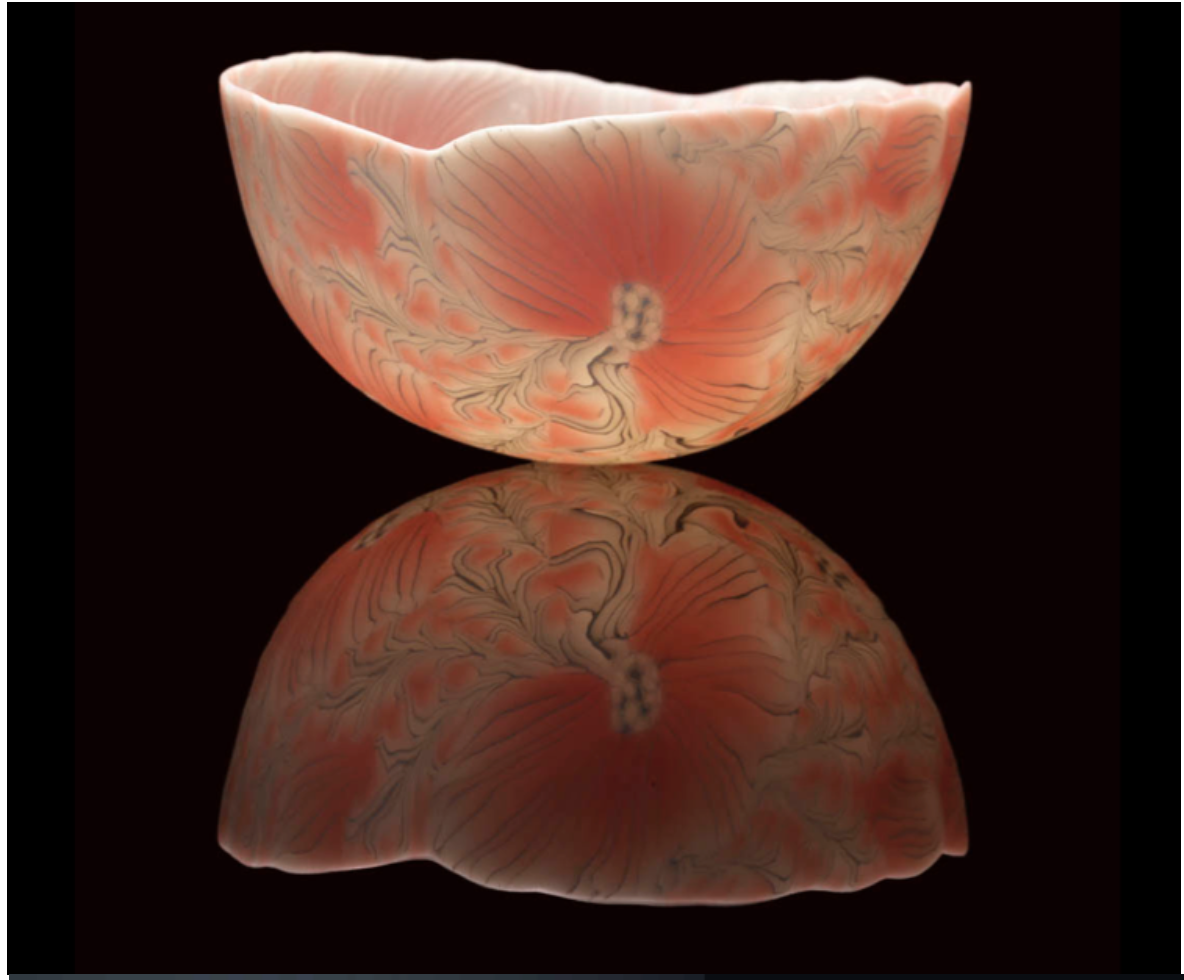
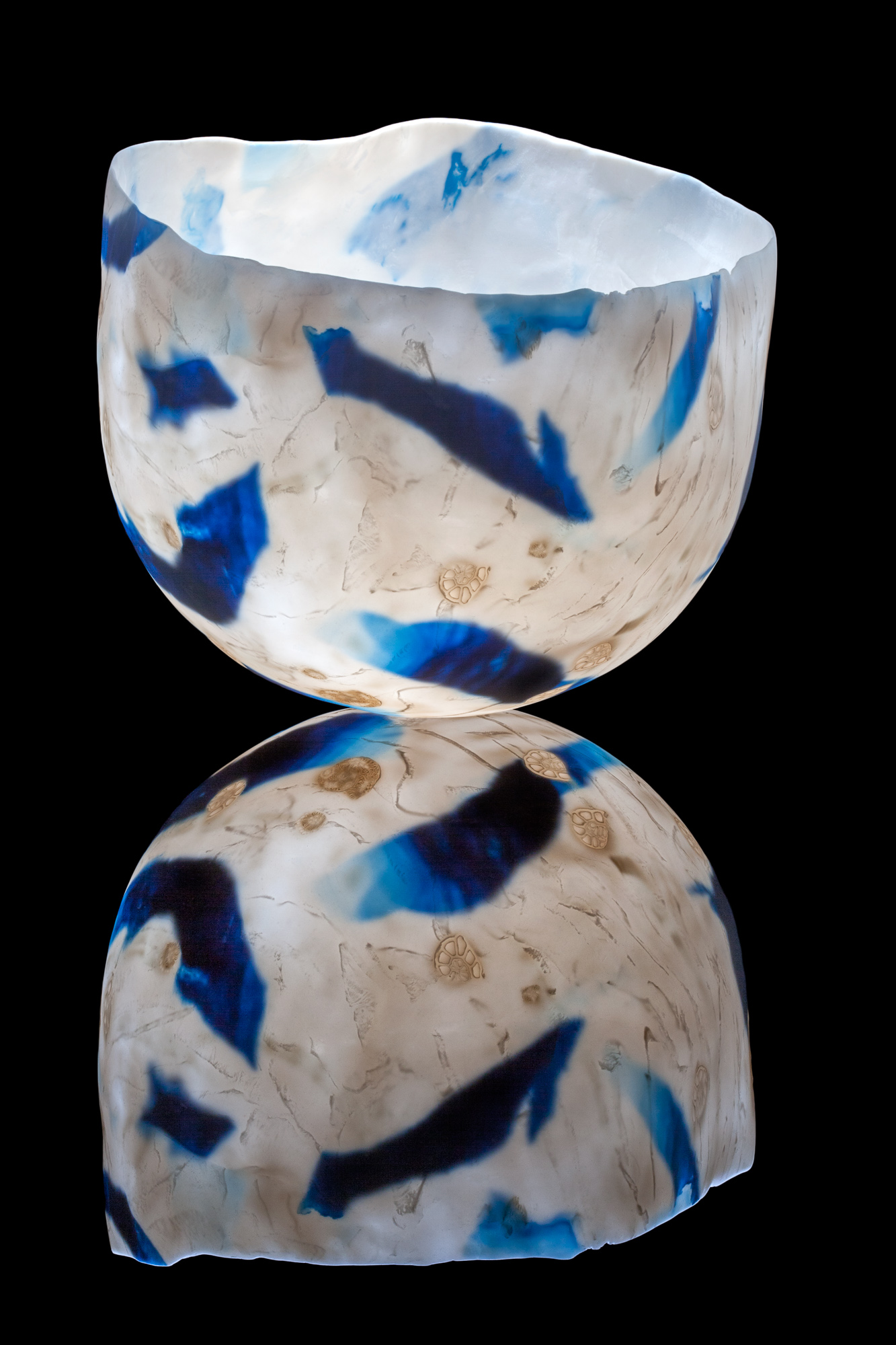
Dorothy developed a new translucent architectural porcelain for Inax (2000~2002) that can fire in one hour in a tunnel kiln. She still uses it with different firing cycles. Before Dorothy developed her translucent white white expression, it was not necessary for her photographers to make mirror photos to explain the translucency. The white white translucency chameleon nature (changing with type of light & direction) is easier to explain to the viewer with mirror images. To explain the type of white/white + color nerikomi details after 1995 especially where the light hits the work, the impression & expression changes. She uses one of whites as the accent where light projected on the line is white and light behind or through the accent changes to gray . To express this before she introduced the mirror type photo, she used two photos. Like in the geometric sake cup below.In daylight you see both easily. The cameras on the new HDR phones see it all.
(this is the same geometric piece light on light through using an SLR camera and film) She was using her using her methods to make work before she was aware of there being Chinese pictographs and Japanese Kanji to describe a similar method similar to how she works. She has always also been open about how she works with two or more white porcelains. She puts aniline dye or food coloring into her batches of porcelain she makes so that she can know which materials were used and she can see what she is doing when she laminates them together. Her main dye colors when she demonstrates are pink or green but she uses others. https://www.youtube.com/watch?v=Byn7O_B_uHI
Demonstration at Canberra University, Australia 2004 White/White demonstration using aniline dye so she can see the patterns of the whites. This dye burns out in the firing. She almost always uses green and pink but sometimes purple and yellow aniline dyes depending on how many whites she is using Porcelain manufacturers in Europe differentiate types of white clays this way so they know which clay is for turning, casting, handles or flowers. She colors with aniline so she can laminate two whites. No one needed to use aniline dye for making white/ white nerikomi before her, because she was the originator of this expression.She experimented before that earlier in the late 70s early 80s but, went on to develop colored clay for sale by Potterycrafts. Her first successful white/white pieces were made in 1995 in Hungary. She does not use any secret Japanese techniques to create her expression. She developed her processes herself after she saw and bought glass beads in the Berger Bead Museum in Los Angeles in 1967.
Berger bead purchase. This museum no longer is open. She was inspired by Italian glass beads used as currency in Africa but was working in clay in 1969 and figured how to make similar laminating/caning/millefiori/marquetry/marbling imaging in clay. She has almost always made very precise images using at least 2~-80 porcelain color gradations. First she made beads then larger objects.
Dorothy’s first beads 1969~70.
In 1969, there were few books on glass caning techniques so she figured out how to make images in clay that were similar to making images in glass by herself. Another student at her university was throwing marbled clays and he gave her his clay to use for her handbuilt millefiori when he lost interest. In 1971 her teacher showed her a book by Herbert Saunders about Japanese ceramics with a similar piece to her first small dish but imaging not as controlled as hers and in the book it was called neriage. She later used the description nerikomi because she was working in Japan and Yusuke Aida gave her an award and called her work Nerikomi so when she gave lectures in Japan she said she constructed her work like nerikomi because most Japaese potters were familiar with that description of using more than one color of clay to construct an object. If you want more historic and technical detail about white/white refer to earlier post http://nerikomi.blogspot.jp/search/label/Lecture

10/09/2021

New work Exhibition at Cera Gallery in Tokoname, April 29, 2022~May 9, 2022

There will be an exhibition of Dorothy Feibleman's new translucent work at the Cera Gallery in Tokoname, Japan, from April 29th, 2022 to May 9th, 2022.

9/18/2021

Ichinokura Sakazuki Art Museum Group Exhibition 9/17~10/03 2021

Dorothy is exhibiting some new pieces.

Mino International Ceramic Competition Award 2021

Dorothy's work was given an award in the Design section and her work was selected in the Art section.

4/04/2020

Dorothy's "WAVE" Bone China Tableware - NIKKO

Dorothy's Nerikomi "WAVE" Expression - Bone China Mug
https://www.nikko-tabletop.jp/products/list.php?series_id=613

2/27/2020

Metropolitan Museum of Art 150th Anniversary Celebration Surprise Gift

The Metropolitan Museum of Art sent a letter of appreciation to all living artists with work in the Met's permanent collection. This piece below is in the permanent collection. Along with the letter, they sent an unlimited access card to the Met's collection, for life. It says: "Dorothy Feibleman Artist in the Collection" on the reverse side with the ID number.
Asymmetrical White/White Textured Nerikomi Photo by Mark Johnston

1/24/2020

BBC 4 "The Great Pottery Throw Down" Nerikomi Challenge - Dorothy Feibleman Judge

On the third episode of the newest BBC4 "The Great Pottery Throw Down", broadcast on January 22, 2020, laminating clays/nerikomi was the surprise challenge. Dorothy Feibleman was the guest demonstrator and guest judge for this challenge.
https://youtu.be/a005Bs-qKAA


Dorothy has been developing her laminated translucent porcelain expression since 1969 (nerikomi, neriage, jiaotai, nerikomi zogan, etc.)
for more history refer to previous page https://dorothyfeibleman.blogspot.com/2019/

9/05/2019

Nerikomi Troubleshooting information from 2010 replaced to this blog


from a post on Wednesday, October 20, 2010, nerikomi.blogspot.com
ドロシー・ファイブルマンの歴史と技法
Dorothy Feibleman's History and Expression
(this talks about exposure in Japan not her laminated translucent porcelain history between 1969~1993)

ドロシー・ファイブルマン氏は、2007年に岐阜県多治見市の市の倉さかづき美術館工房で行われたワークショップで、透光性のある磁器練り込みのクラスを教えました。

Dorothy Feibleman held a workshop in 2007 at the Sakazuki Museum in Tajimi, Gifu.

The Inax design prize gave her translucent colored laminated porcelain expression a lot of exposure in Japan in 1993. After 1993 she was awarded many opportunities. Dorothy exhibited her White/White ("Nerikomi") Expression in 1999, at the Green Gallery in Tokyo at the time of her Japan Foundation Fellowship and another residency at Shigaraki. After being awarded a gold at Mino in 2002, for her White/White ("Nerikomi") Expression, she exhibited her translucent laminated expression at Ichinokura Sakazuki Museum in 2003 and 2007 & gave slide lectures. She also exhibited at Yufuku Gallery in Tokyo in 2006. After which, she held a workshop in 2007 at Ichinokura where she showed her original expression GEOMETRIC 1,2,3,4,5 slides shown below marked DEMO showing her original use of dyed green and pink clay that is actually white. The dye burns out in the firing. She demonstrated some of her other original translucent laminated expression. At least since 1975, she has fired all her non-glazed porcelain in silica sand in saggars. She fired her student's work at Ichinokura in silica sand & made small saggars for the student work firing.  
Abel Lakatos filmed pink gradation, gradation spiral, Dorothy Flower Petal, and Blue Star when she was on residencies & teaching several times in Hungary :
Some of these below are on: http://nerikomi.blogspot.com/2012/07/
pink gradation demo
https://www.youtube.com/watch?v=tK10XY6OpRI
gradation spiral 
https://www.youtube.com/watch?v=XGLfVS2V4VI
Dorothy Flower Petal 
https://www.youtube.com/watch?v=onSG08Js3Dk
Blue Star 
https://www.youtube.com/watch?v=a9Y_BNUeEN4

白/白さかづき(上写真)
2002年金賞美濃コンペティション受賞
The WHITE WHITE SAKAZUKI pictured above the demo photos, won a gold prize at Mino in 2002.

また1997年と1999年には、滋賀県信楽にある陶芸の森の工房にゲストアーティストとして滞在し、作品制作およびワークショップ&レクチャーを行いました。1998年には信楽窯業技術試験場で講演を実施しました。今回、彼女が今まで約40年間に渡り用いてきた、練り込み磁器の制作方法を紹介します。
In 1997 and 1999, she was a guest artist at the Shigaraki Ceramic Cultural Park, Shigaraki, Shiga Prefecture, where she produced works, conducted workshops and gave lectures. In 1998 she gave a lecture at the Shigaraki Ceramics Technology Laboratory. "Here is an introduction to how Dorothy makes her laminated porcelain that she has been making for 40 years". (now 50 years)


Photo Left: By Tomoki Fuji. Shown at an exhibition of Dorothy's work at Ichinokura Sakazuki Museum in 2003
Photo Right: Hungarain church in Transylvania by Dorothy Feibleman 1973


Photo: Dorothy Feibleman 2005
Here is a very short slide show of how the type of piece above was made. She always fires her work in silica sand in saggars as shown in this slide show. This is not a secret technique. It has an English industrial history.
https://www.youtube.com/watch?v=yjKCyX4PVwQ

The 5 slide videos below were made in Australia in 2004 for a class at the University of Canberra photographed by Greg Daly.

Dorothy was using white porcelains in these slides. As mentioned above, the pink and green colors burn out. The fired pieces were white like the ones above in this post. It is standard procedure in porcelain factories for material and process identification to put dye in porcelains used for different processes. This makes it easy for staff to access the correct clay type so they can move it to the area of the factory where it will be used. If not dyed, the white porcelains may look like the same porcelain and be the same porcelain sometimes, except for the plasticizer used for flowers or jigger jolly or casting, etc. Dorothy has (since 1995) used dye to identify her different whites she is laminating. This allows her to see what patterns she is making with white clay and to identify the translucency or color of different whites or opacity in each structural image she is making. Understanding this is important for her final expression after firing. Placement of white colors, textures and structural movement is all part of her expression. Aniline dye was used in industry to identify factory porcelains so they were moved to the correct departments. Historically, white white translucent nerikomi did not exist before Dorothy developed her expression. Her invention of using dye which burns out in firing was essential for her to achieve her unique white white translucent signature expression.


The piece above (1999) made from several white porcelains. It is a similar construction imaging to the below demos. This piece was partially made in the UK and Japan in 1998-9 and finished at the Seto Ceramic and Glass Studio on the residency in 2000. There was a second one made from the same images but it was not perfect. It "was lost" by ...... there was a police report in Seto.
It is still "lost" probably in someone's private collection of endangered species items.

These two above photos are from a powerpoint presentation given in Hungary & in Japan.
Photo of the piece: Mark Johnson.
Photo of gate in Romania: Dorothy Feibleman.

geometric 1 透光性のある磁器練り込み ドロシー DEMO

geometric 2 透光性のある磁器練り込みドロシー DEMO

geometric 3 透光性のある磁器練り込み ドロシー DEMO

geometric 4 透光性のある磁器練り込みドロシー DEMO

geometric 5 透光性のある磁器練り込み ドロシー DEMO

透光性のある磁器”練り込み”は、西洋的には顔料を混ぜた磁器土、または異なる白い磁器土を使用し制作されたものです。ドロシー・ファイブルマンは、構造的な透光性のある練り込み磁器を開発した最初の陶芸家で、構造的な透光性のある磁器土を使用し続けて37年になります。当時日本には透光性のある練り込みは、その長い歴史を見てもありませんでした。
Translucent porcelain "kneading" was produced using porcelain clay mixed with pigments or different white porcelain clays. Dorothy Feibleman was the first potter to develop her particular expression of structural translucent kneaded porcelain, and has been using structural translucent porcelain soil for 37 years. (now 50 years). At that time (1969), there was no translucent expression of kneading like Dorothy's in Japan, even with a long history. Not sure where this was quoted from at the time it was put in this blog but it is off by about +3 years.

ドロシー・ファイブルマンが初めて日本に構造的な透光性のある色付きの練り込み磁器土を紹介したのは1993年でした。1995年以前、彼女は制作に凹凸や平面に色の付いた磁器土を使用していましたが、1995年のハンガリーでの制作活動以降は、彼女のレパートリーに平面と凹凸を透光性の異なる白い磁器土を使用したものが加えられました。
In 1993 Dorothy Feibleman introduced the first structurally translucent colored kneaded porcelain clay to Japan. Before 1995, she used porcelain clay with textures and colored surfaces, but since working in Hungary in 1995, her repertoire increased to using white gradations with different translucencies, and textures.

そのハンガリーの磁器土には、チェコ・カオリンが含有されていて、彼女はそれを透光性のある白い磁器土と組み合わせ、まるでプリカジュールかステンドグラスのような模様のブロックに作り上げます。濃い白が構造の中で強いほど、透光性のある磁器土は内へ溶けます。①凸凹、②凹凸、③平面の3種の仕上がりは、焼成の温度と焼成時間によって決まります。基本的に、これら3種の凹凸効果は焼成から出されることになります。
The Hungarian porcelain clay she used, contained Czech kaolin, she laminated it with her translucent white porcelain clay to make canes with a pattern like Plique a Jour or stained glass. The stronger dense white porcelain in the structure with the less translucent porcelain allows the more translucent porcelain to melt inside the stronger structure. The three finishes (1) 凸凹 unevenness, (2) 凹凸 unevenness, and (3) 平面 flat surface are determined by the firing temperature and firing time and her materials used. Basically, these three types of surface but actually structural unevenness come during all drying and firing and choice of materials in the clays.
What is not clear in the translation is that there are two texture types and the clays melt at different temperatures and move when they mature or are still porous.

1.凸凹 ガラス状の丸い構造(液体を透過しない)
1. Uneven/textured Glass-like rounded structure (is vitreous and does not leak)


Dorothy Feibleman © 1995 / Dorothy Feibleman ©1999

2. 凹凸
2. Uneven/texture


凹凸の構造のうち、濃い白色が盛り上がり、角になっている部分はつや消し効果の白磁器土を。また、凹んだ部分は、わずかに光沢のある白磁器土が使用されています。このような凹凸構造は、光が当たると影をつくり、やわらかく、ベルベットのような印象を与えます。しかし、このつや消しになっている部分は素焼きのようになっており、置き物用の作品にのみ適していると言えます。また、防水性がなく、多孔性になっているので、水を入れると浸透し、色のついたもの(お茶類、ワインやしょうゆなど)を入れるとシミになってしまうので、食卓用の食器としても使用しないほうがよいでしょう。

***国際的には、食品衛生法などにより、シリコンの防水剤は食卓用の食器には適していないとされています。

In this example, the white matte is not mature. In addition, the recessed parts of the image are made of vitrified white porcelain clay. This uneven structure creates a shadow giving it a soft, velvet-like impression.

However, this chalk like raised part is like a low fired bisque unglazed piece, it is not suitable for use with food. Also, since it is not waterproof and porous, it absorbs water and becomes weaker, stains when exposed to oil, tea, wine, soy sauce, dirty finger prints, etc. It is very weak so it is not usually good for large work. 

*** Internationally, silicone waterproofing agents are not suitable for tableware due to food hygiene laws.

3.a. 平面
3.a. Smooth


作品全体が、素焼きのようなつや消し効果や、わずかに光沢のある磁器土を使用していなければ、それはガラス質(水漏れしない状態)であり、シミにもならず、そして食器としても使用できます。
If the porcelains used are chemically suited to each other they will vitrify within the same firing range.


(http://dorothyfeibleman.blogspot.com/2010/07/blog-post.html, enlarged image)
Made in the UK in 1995 and 1997 and first shown publicly in Japan at the Seto Ceramic and Glass Center when she was a resident.

3.b. 波状の面
3.b. Wavy surface

もし、二種類の磁器土が使用されていれば、どちらの土もガラス質になりえます。しかし、両方の磁器土の収縮率が同じとは限りません。結果として、水面上の小さな波のような大変面白い効果が得られますが、どちらの磁器土もガラス質になっていればシミになることはありません。(http.//dorothyfeibleman.blogspot.com/2010/07/blog-post.html,同じ画像の拡大)

If two types of porcelain are used, However, the shrinkage/vitrification point is within the same range of both porcelain clay but is not always the same. The result is a very interesting effect, like a small wave on the surface of the water. 


ドロシー・ファイブルマン氏は、混ぜ合わせることのできる7色の透光性のある磁器土を利用できるようにした最初の陶芸家です。透光性のある色付きの磁器土は5色あり、さらに透光性のある白と黒は際限なく混ぜ合わせることができ、様々な色の表現を可能にしました。その磁器土は、1984年からヨーロッパのポドモレス社(後にポッタリークラフト社)で、その会社がリモージュ社の一部門になるまで販売されていました。


Dorothy Feibleman was the first ceramist to make available to the public, seven intermixable colors of translucent porcelain clay. It was sold by Podmores in Europe (later Potterycrafts) from 1984 until the company became part of Limoges.


練り上げの人間国宝、故松井康成氏は、1997年に信楽にある陶芸の森で彼女の制作した透光性のある白と白の凹凸のある器を見た後、彼女の磁器土に興味を持ち、後に同じ磁器土を2トン、イギリスの原料店から購入しました。
In 1997, the late 松井 康成 MATSUI KOUSEI saw her translucent white and white textured vessels she produced at Shigaraki Ceramic Cultural Park. Like the small cup pictured on the left below. He said to the translators, "I want her clay" and Dorothy told him anyone could purchase it from Potterycrafts (the D.F. colored porcelain sold since the early 1980s). He purchased one ton of Dorothy's dry translucent porcelain clay from Potterycrafts U.K.


photos above and below: Mark Johnston


これらの透光性のある白の凹凸のある作品の一つが、1998年の国際陶磁器フェスティバル美濃の芸術セクションにおいて展示され、後にニューヨーク市にあるメトロポリタン美術館に永久収蔵品として購入されました。

This white/white translucent piece was displayed in the Art Section 1998 at International Ceramic Festival Mino. It was soon purchased for the permanent collection at the Metropolitan Museum of Art in New York City.

This page was mainly about white/white work and was put on in 2010 in English.
Below is a piece that was in the same Mino '98 as the work that the Metropolitan Museum acquired.
It was made from translucent porcelain but was not photographed with light. It looks totally different with light shining through it.


In 1998 Mino Competition, Dorothy was awarded a silver in the design section for this piece of her colored work.
會田 雄亮 Yusuke Aida was the head judge in the design section that year.

1986年、岐阜県の国際陶磁器フェスティバル美濃において、初めてドロシー・ファイブルマン氏の作品が展示されました。彼女が陶芸家として日本に定着したのは1993年で、1997年以降、その存在感を著しく確立していきました。2000年のINAX実験工房での制作活動後、愛知県常滑市に独立工房を立ち上げ、現在もそこで制作活動を続けています。
In 1986, Dorothy Feibleman's laminated porcelain work was exhibited for the first time at Mino International Ceramic Festival in Gifu Prefecture. She won the Inax design prize in Japan in 1993, and since 1997, she has been making work in Japan regularly. After her production activity at the INAX Experimental Studio in the early 2000s, she established an independent workshop in Tokoname City, Aichi Prefecture.


Resurrected from 2010 posting on nerikomi.blogspot.com and translated back into English. Translation is in blue. red or magenta new added info.

8/03/2019

Dorothy's "WAVE" Bone China is at BARNEYS

Dorothy Feibleman's "WAVE" 
"New nerikomi" tableware made from bone china by Nikko - available online at BARNEYS


AVAILABLE ALSO ON THE NIKKO WEBSITE ADDRESS BELOW: https://www.nikko-tabletop.jp/products/list.php?series_id=613

2/26/2019

Some of my ancient history 1978~1981

Exhibition at the Craft Potters Gallery, London, UK, 1981
Creamer, Teapot, and Fish furniture 

Photo: David Cripps


Tiger Barbs Top Dwellers
Small Cichlids Bottom Dwellers
Crayfish Dwelling mainly in the double walled checkered nerikomi zogan form
"Elephant" fish aquarium is not displayed
"My work at the CPA 1981 exhibition displayed 4 large tanks,
ceramic forms, brooches (hanging), and my fish as an installation".
Made from 1978 to 1981

2/22/2019

DOROTHY X NIKKO - Dorothy's nerikomi expression in bone china - online catalogue


Dorothy's nerikomi expression in bone china produced in Japan by Nikko Ceramic Company
Catalogue online today.
Three new lines by Dorothy. 
CLOVER, WAVE, GEOMETRIC


The catalogue is also coming soon in English.  
There are three new ranges.


COLLECTION
"I made the pastry (in the photo with the tea) on my new bone china tableware. I have made it since about age 10. Many people who taste it think it is from their country. I used to take it to Lucie Rie when I would visit her. It makes everyone happy. Here, I have put my general version, that I sent to a friend, one of the times I was a guest artist at Togei no Mori, in Shigaraki. When I was at university, I would put it in the freezer and secretly bake it in the test kiln (do not do this it is bad workshop practice) when the teachers were in meetings. They would come back and comment that the department smelled wonderful. But,it would all be gone by the time they finished their meetings. I came back after Christmas break one year and Caroline (a graduate student) had eaten it all and the freezer was empty. She couldn't stop eating it over the vacation. It even made my very dry humoured teacher Franz Wildenhain smile. He left a meeting for it - he had a good nose.  Making it is similar to making my ceramic work. It is structural. I do serve my edible work  on my work often.  I always make it when I give workshops. Since then, I must admit, that as an Inax Design Prize winner, in 1993, in Japan, I did bake a noteworthy chocolate cake (a recipe from Lucie Rie's family that she gave me) in a ceramic dry box in our workshop (not in the company). It took 4 hours but it worked perfectly. (I am not recommending dry boxes or kilns for preparing food in . But,I have a horrible suspicion, all potters do this at some time in their lives with the full knowledge it is idiotic. At the time it seems convenient, But, we all know it is really a bad idea). I have worked in companies (in the 20th century - I did not say 21st century) where at 2a.m. I have smelled steak and followed the smell and there it was, on the kiln shelf at the end of the tunnel kiln, a thick sizzling sirloin steak and onions and baked potato in foil, on aluminum foil, next to a cooling down product."

The recipe is below:


"The pastry only recipe can be frozen in the pastry stage before you make it into anything. It is good as a blind cooked pie crust for fresh strawberry pie. After the making, but not cooking stage, you can freeze it and quickly take it out of the freezer to cook for guests anytime. After cooking, if you freeze it, it thaws quickly. Put on the powdered sugar after thawing or when it cools after baking. It keeps well in the freezer at all the above stages." The creamcheese butter pastry is also good for savory things like spinach and ricotta filling, as long as the filling is not wet."(added April 2020) "Regarding the CLOVER tableware I designed for NIKKO; it has many 4 Leaf Clovers in the pattern. I find many 4 leaf clovers when I walk. I notice patterns that jump out because they break the usual general background pattern. I put 4 leaf clovers on my hand made name cards I laminate into Japanese paper. I usually find clovers anywhere I go. Anywhere in the world. I pick about 20~ or more 4 leaf clovers in a 10 minute walk".(added April 2020)